
Micro, Small and Medium Enterprises (MSME)
The Government of India passed the Micro Small and Medium Enterprises (MSME) Act, 2006 on 16 June 2006 and it was notified and implemented on 2 October.
In this Act, micro, small and medium enterprises have been defined in different ways and their scopes have been specified.
Small and medium enterprises form the backbone of industrial development in any country.
The Ministry of Micro, Small and Medium Enterprises contributes around 8% to the GDP, about 40% to manufacturing, and nearly 45% to exports.
After agriculture, this is the largest employment-generating sector.
This is an emerging, dynamic and vibrant sector because it is growing very rapidly.
It offers a range of different products and is very helpful in the growth of the country.
It is also very important for entrepreneurship and innovation.
Definition of MSME
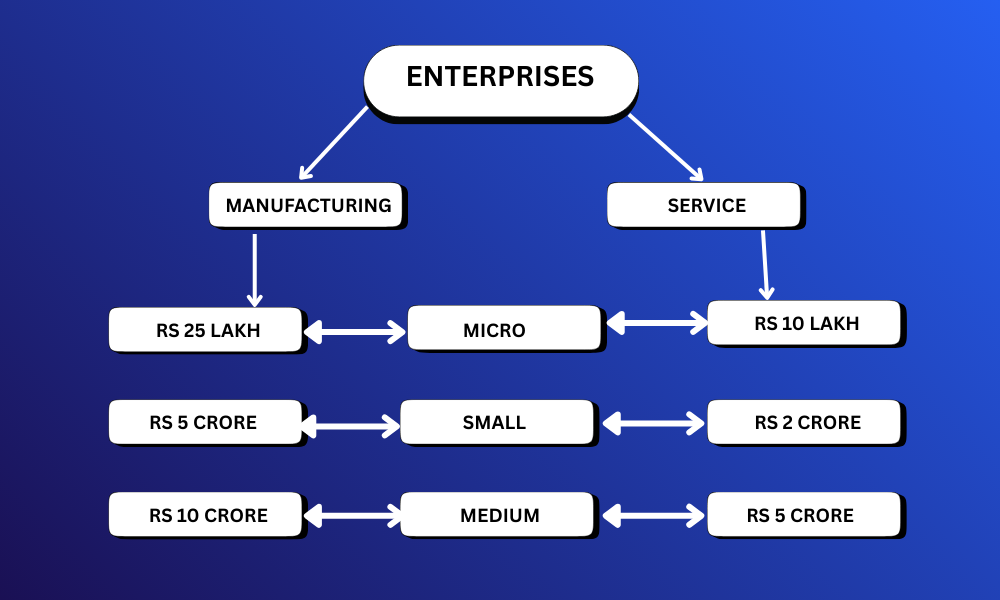
According to the MSME Act, 2006, enterprises are defined on the basis of their investment in plant and machinery (manufacturing) and investment in equipment (services).
MSMEs are divided into two sectors:
Manufacturing Enterprises
Service Enterprises
Classification of Enterprises
Characteristics of MSMEs
- Low cost of production
- High capacity for innovative exports
- High employment generation
- Reduction of regional imbalance
- Greater flexibility in operations
Role of MSMEs in India
- Generation of employment
- Contribution to production
- Contribution to exports
- Optimum utilization of available resources
- Increase in Gross Domestic Product (GDP)
Importance of MSMEs in India
- Facilitates the growth of women entrepreneurs
- Brings balanced regional development
- Helps in the mobilization of local resources
- Paves the way for optimal utilization of capital
- Promotes exports
- Complements large-scale industries
- Meets customer demand
- Ensures social advantages
- Develops the importance of entrepreneurship
Problems of MSMEs
- Financial problems due to limited credit availability (only up to 30%)
- Poor quality of raw materials
- Technological problems, including limited advertising
- Managerial problems due to lack of skilled managers
Suggestions for Improvement
- Proper supply and adoption of technology
- Conduct surveys and research activities
- Create awareness among entrepreneurs
- Involvement of stakeholders
- Strong interaction with the Research and Development sector
- Promotion of venture capital
Advantages of MSMEs
- Close supervision
- Higher employment generation
- Requires small capital investment
- Direct relationship between workers and employers
- Easy management
Disadvantages of MSMEs
- High cost of production
- Limited use of machinery
- Lack of specialization
- Difficulty in obtaining loans
- Costly raw materials
- Lack of proper research
- High competition
Government Schemes for MSMEs
- Prime Minister Employment Generation Programme
- National Manufacturing Competitiveness Programme
- Scheme of Fund for Regeneration of Traditional Industries
- Performance and Credit Rating Scheme
- Assistance to Training Institutions
- Marketing Assistance Scheme
- Credit Guarantee Fund Scheme
- Credit Linked Capital Subsidy Scheme
- Coir Udyami Yojana
- Coir Vikas Yojana
- Mahila Coir Yojana
- Micro and Small Enterprises Cluster Development Programme
- Tool Rooms
- International Cooperation
Institutions for MSMEs
Central Government Institutions
- SSIB – Small Scale Industries Board
- NABARD – National Bank for Agriculture and Rural Development
- SIDO – Small Industries Development Organization
- NSIC – National Small Industries Corporation
- KVIC – Khadi and Village Industries Commission
- SIDBI – Small Industries Development Bank of India
State Government Institutions
- SFC – State Financial Corporation
- SSIDC – Small Scale Industries Development Corporation
- TCO – Technical Consultancy Organization
Non-Government Institutions
- Indian Council of Small Industries
- Laghu Udyog Bharati
In this content, you have studied Micro, Small and Medium Enterprises (MSME) including their definition, manufacturing and service enterprises, characteristics, role, importance, problems, suggestions, advantages, disadvantages, government schemes, and institutions.